
You can never hold back spring
mourning Tim Thomas, Michael Harrison, Greg Foreman & Sleepy Doug Shaw
AHB’s Goodies is a mixtape delivery service for music discovery, without algorithms. I’ve prepared this welcome page to explain what it’s all about.
Consider a paid subscription for exclusive access to my Artist Primers and Genre Primers—dozens of playlists exploring individual musicians and specific sonic worlds, from vintage African music to power pop.
# of Tracks: 29 recordings
Length: a bit more than 90 minutes
Themes: memorializing Tim Thomas, Michael Harrison, Greg Foreman & “Sleepy” Doug Shaw ~ spring as a dream of renewal & the denial of death ~ a distant, out-of-focus aesthetic ~ quiet music as self-care ~ fading lights & American empire ~ the hazy sound of room tone captured by microphones ~ muffled tones that emphasize sweetness ~ 19 tracks with vocals, 10 mostly instrumental ~ songs about earthly pain & spiritual ascension by Dadawah and Morphine ~ 6 tracks released this year (4 since May), because you can graft new art to old roots and be left with something stronger
Links: Spotify | Apple Music | YouTube

Hi world, it’s me again, Mr. Thinking About Death Too Much, writing this note to you on the hazy last days of astronomical spring.1 My head’s been muddled this season because I’ve spent too much time lingering over memories of the recently deceased. This is my attempt at a death contemplation.
Over the past two months, I’ve tried and failed to write this a half-dozen times because the scope of the reflection kept expanding. On a global scale, there’s been America’s bumbling war against Iran, waged by a president who aspires to be king. More intimately, there were a string of unexpected deaths among musicians in their forties, fifties, and sixties. Maybe they hit different because I am now over fifty myself? Or perhaps it’s just that I’ve long looked to music scenes to give my life structure. Music is a generative force. So to see the lives of other people devoted to its restorative power unfurling, one after another…
It started with Tim Thomas, who died six months ago on January 24—the same day as my birthday, a coincidence that’s kept the date lodged in my memory. Tim and I worked together in the mid-2000s at Bang on a Can, a new music organization. He was their primary fundraiser for almost two decades; I managed their record label for a couple years. Recent events had put us back in regular contact.2 The night he died, he was at Carnegie Hall watching a So Percussion concert I had planned to attend.
When Tim left Bang on a Can, he became So Percussion’s first ever executive director. The previous fall, I’d visited him at his office in the Brooklyn Navy Yard. He handed me the new box set celebrating their twenty-fifth anniversary, then walked over to the stereo, turned up the volume, and theatrically rocked out to one of the recordings that connected us. (Head banging, arms pumping in time with the beat.)
He called again as the holidays approached, this time with more intention. A residency was taking shape in Vermont. He had a venue, an institutional partner, and some ideas about funding it, but thought he’d need help recruiting some musicians outside of his immediate circle. The model for these events would be the PEOPLE Festivals in Berlin, which I’d attended in 2016 and 2018 and still count among the most memorable musical experiences of my adulthood.
Tim said we’d figure out the details later.
Was I in?
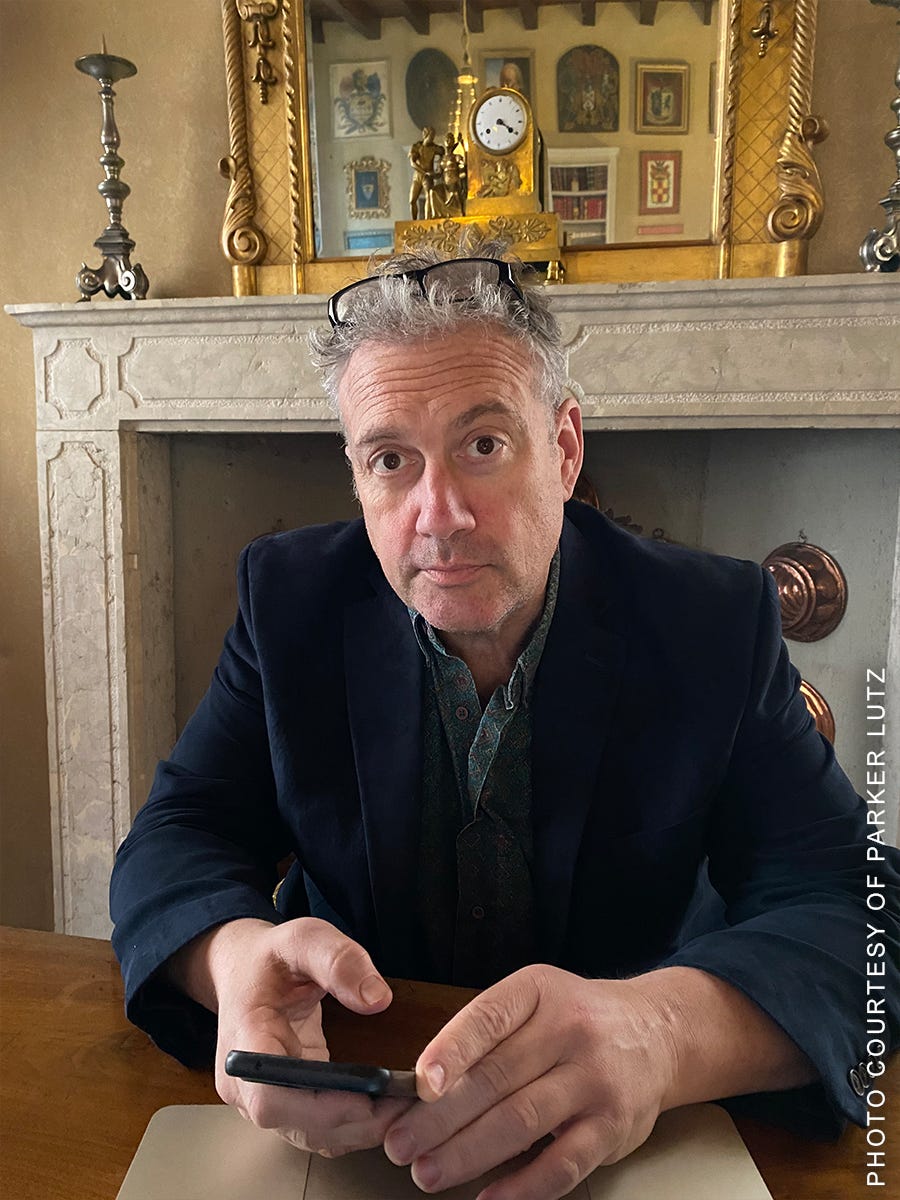
Cool things happened when Tim got excited. He was expansive, conspiratorial, a little crazy—the good kind of crazy that makes culture happen because it ignores the chorus of rejection the world aims at creativity: that art isn’t valuable, that there is no return on investment, that musicians are unreliable, and anyway, can’t we just click on the latest thing from Taylor Swift or sports or Netflix?
He warmed every room he entered. Making music happen was threaded into his being in a way that felt deep, sincere, and entirely beyond any need for recognition.
As spring arrived, Tim’s death was followed in quick succession by those of Michael Harrison, Gregg Foreman, and Doug Shaw. None of them were the sort of musician to receive a front-page obituary in a newspaper of record. The remembrances happened elsewhere: in Instagram stories, newsletters, Facebook posts, group chats, and private messages—the kind of forums that pass for intimacy in digital culture.
I actually worked with Michael on his album Revelation, which remains a career highlight because that LP feels more enduring than many of the more commercially successful projects I’ve been involved with. He was soft-spoken yet deeply focused. We last exchanged emails a few years ago, when he wrote to see if I’d consider releasing a new record he’d just finished. Given how much streaming has shifted the market for recorded music, I wasn’t sure where his work would fit commercially. But I’m genuinely grateful so many recordings of his exist. Since his death, I’ve spent considerable time with a pair of recent releases Seven Sacred Names (2021) and Evening Light: Raga Cycle I (released earlier this year) which extend the vision of his masterpiece Revelation into Sufi and Indian traditions.
Gregg Foreman and Doug Shaw were relative strangers or, rather, a more contemporary kind of “friend.” People I didn’t know, yet knew anyway because so much of modern life unfolds through digital networks and a social media timeline. I clicked “like” on particularly poignant remembrances of Gregg from mutuals, and listened to a playlist about a self-proclaimed genre he called Moth (Mod + Goth) which he’d assembled at the behest of a common friend.
Doug’s death felt especially uncanny. I have no distinct memory of us ever being introduced, yet his face and mannerisms were familiar to me. During Brooklyn’s peak indie years (roughly 2008 to 2015), I spent more hours in the same rooms as him than with any single member of my family. We attended the same shows and parties. We inhabited overlapping circles of art-music lifers. We had many mutual friends and acquaintances.
I know so many who considered themselves part of Gregg and Doug’s chosen family. I messaged some of those people to ask if they were okay, using the same terse language people had used to ask me about Tim: What happened? Will there be a memorial?
All these deaths were fed to me repeatedly over a series of days. Every time I looked at my phone, there was another anecdote or photograph, filtered through a screen and never consummated into something real. Suggested posts rather than warm looks. Pings and notifications instead of actual conversations. Memories reduced to what fit within a 280-character limit.
I found myself participating in a strange new form of digital intimacy: automated mourning. Those demented algorithms had created a chorus of grief made of literal snapshots, leaving little room for more resonant IRL feeling.
I had moments where I questioned what it even means to know someone anymore, what it means to make a mark, what drives us to make art in the first place.
After months of struggling with how to sit with these losses—especially Tim’s—I assembled this playlist quite suddenly and accidentally. I don’t usually pay close attention to lyrics at first. I’m guided more by vibe and feeling. So I was surprised when I finally focused on the lyrics to one of the first songs I’d selected: “Spring” by Tasha, featuring harmonies from Taja Cheek (L’Rain) and Jamila Woods.
Don’t die now / there’s life to be found now
Green grass grows / spring trees put on a big show
Hold fast to / some dream that astounds you
Like freedom / like freedomNo fear here / no heartbreak crawling near
No grieving / no goodbyes, no leaving
A promise / of sunshine upon us
Alive now / it’s spring now
Alive now / you’re spring now
Later I noticed the Tom Waits song I’d picked carried a similar theme.
You can never hold back spring
You can be sure I will never stop believing
The blushing rose that will climb
Spring ahead or fall behindWinter dreams the same dream every time
Baby, you can never hold back spring
And even though you’ve lost your way
The world is dreaming, dreaming of spring
Tim, this city is less without you, brother. And yes, I’ll use that word, even if it feels a bit cringe to put it in writing, because it’s a word you would have used without hesitation. Because that’s how you talked to people: like a believer, like a friend, like someone proselytizing, and perpetually finding common cause through art that brings meaning.
This remembrance is about you, not me. Even if there is no longer a you—only those of us left behind—your old friends, acquaintances, and colleagues trying to hold on to what you were actually like, before our memories inevitably soften into something hazier.
Memories and seasons both cycle back. But seasons also turn, and memories can fade. One way to let a feeling go is to give it shape outside yourself. Maybe that’s what art is about?
You can never hold back spring.
Find the playlist on… Spotify | Apple Music | YouTube
The playlist includes songs such as…
^ Tasha featuring Jamila Woods & L’Rain: “Spring”
^ Toumani Diabaté: “Cantelowes”
^ Tom Waits: “You Can Never Hold Back Spring”
^ Jack Johnson & Hermanos Gutiérrez: “Hold On To The Light”
^ Jessica Pratt: “Empires Never Know”
Bonus:
• Knicks in five: I like to make fun of sports, but I’ll admit I got way caught up in the Knicks playoff magic—so much that I’ve temporarily (?) changed this newsletter’s palette to reflect the team’s orange and blue colors.
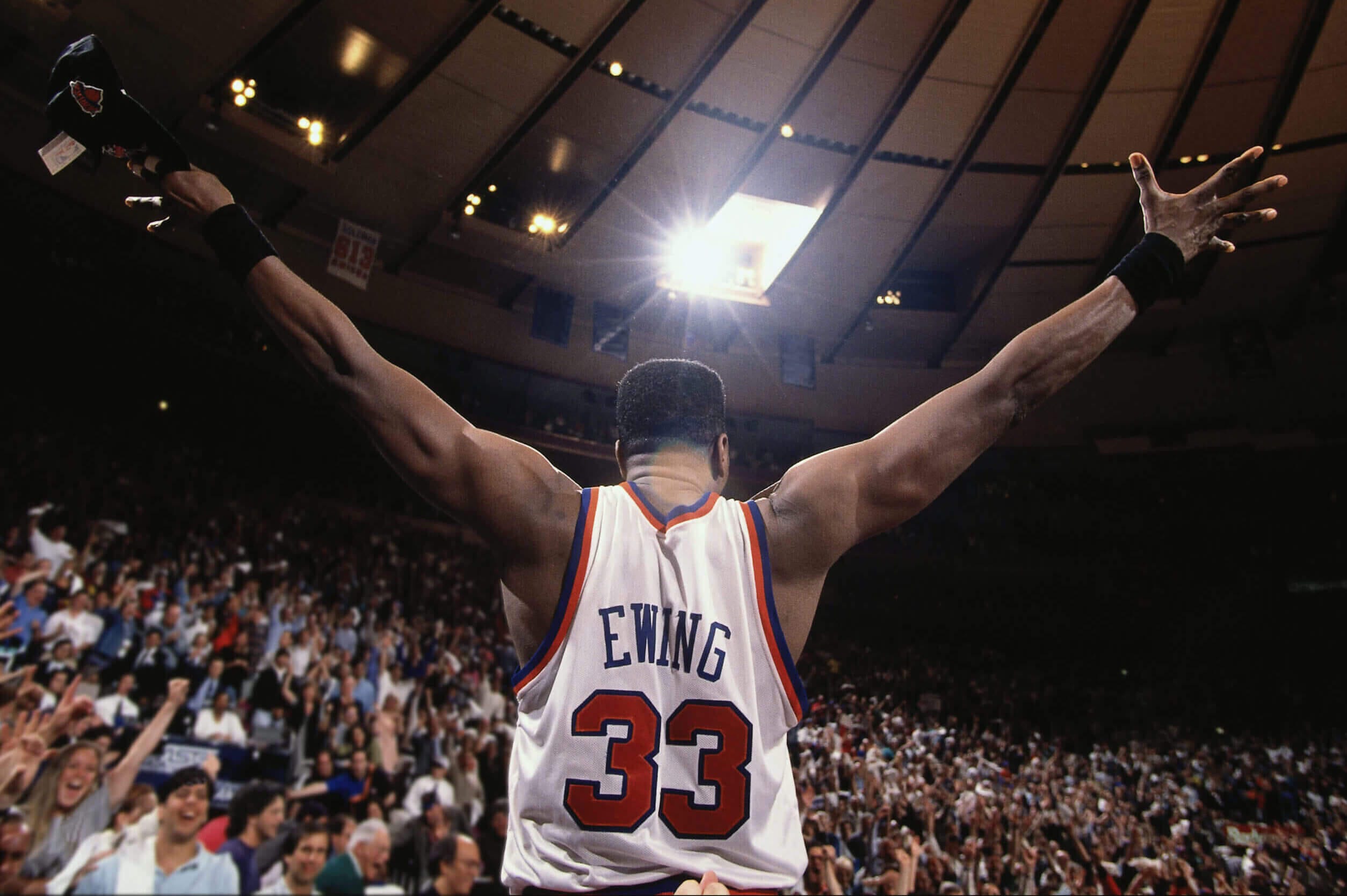
I initially fell for the Knicks during their Patrick Ewing years, which were equal parts hopeful and tragic. I'm sure it's no coincidence that I fell in love with music during that same 1990s period. Teenaged feelings run deep.
The Finals series inspired a new and iconic viral chant from one fan, which spawned numerous variants, my favorite being:
My mayor Is Muslim
My bagel is Jewish
Trump killed the vibe
Knicks in five
What’s the vibe our president tried to kill when he attended game three of the playoffs? I'll quote John Ganz, who contributed one of the many pieces explaining with how awesome New York City feels these days:
It’s such a particularly great joy to experience when nothing else in the world seems to be going right, and every other big event feels like a gut punch. I will say, as a native who lived through 9/11, Sandy, the blackout, and the desolation that the pandemic brought to the city, it does feel especially sweet and redemptive. It feels that this city, with its young, new mayor and his new type of politics, may be entering a new golden age, although perhaps I’m now a little too old to fully appreciate it.
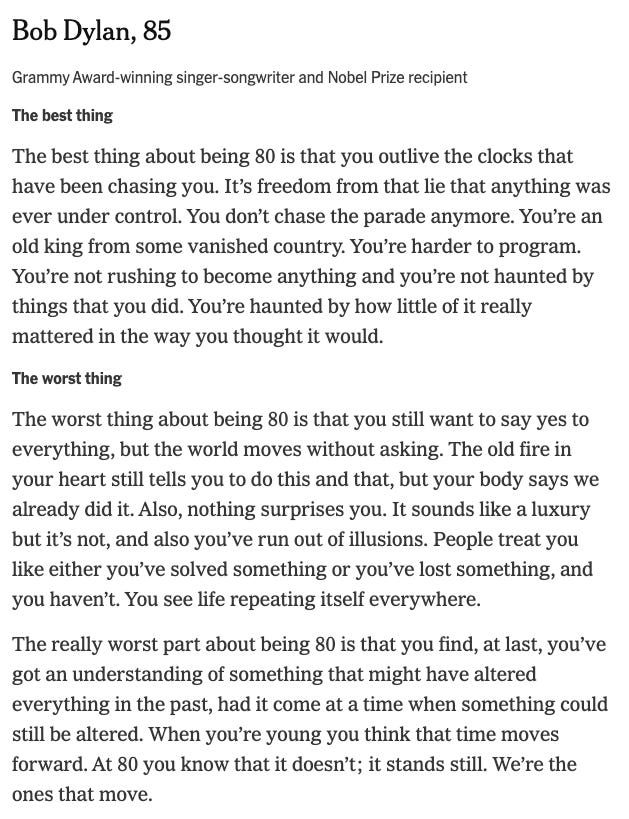
• Bob Dylan’s reflects on being an 80something: In April, The New York Times Magazine published an article about The 30 Greatest Living American Songwriters, which inspired an endless variety of takes—probably the point all along. Dylan was close to a universal pick, a consensus confirmed when he ranked number one in this month’s follow-up Reader’s Poll. (Find my own Dylan playlists here.)
But was it all a ruse to get Dylan to contribute to last weekend’s NYT opinion piece, “Thoughts for Trump,” in which octogenarian American icons offered advice for his birthday? It was a surprising cameo for a guy who goes through entire concerts without acknowledging the audience, but I appreciated it all the more because of that, and his response fits with the theme of the rest of this post.
People Who Died: Tim Thomas • Michael Harrison • Gregg Foreman • “Sleepy” Doug Shaw
I’ve already shared my thoughts about Tim Thomas but I had a bit more to say about the others.
Michael Harrison (October 24, 1958 - April 17, 2026): I already mentioned that I met Michael when I put out his album Revelation in the early 2000s, while working alongside Tim at Bang on a Can. Rather than elaborate on my experience, I’ll point to some lovely writing by Matthew Schnipper in his newsletter Deep Voices. He captures something special here: the intimate experience of letting music in, and how a record can connect to a specific moment in one’s life—in his case, the days after his son Renzo’s death.3
I want to note the death of composer and pianist Michael Harrison earlier this month. He died of complications from pancreatic cancer.
I listened to his music, expressive, magical piano pieces, quite a bit in the time after my son died. “Michael Harrison plays piano for me all day, while I attempt to work, to relax, to do the crossword, to love my wife, to see my friends, to find any reason to be grateful,” I wrote here in Deep Voices in 2022, the year after Renzo’s death. That listening continued, as have those attempts.
I read about Harrison’s death sitting at the kitchen counter with my wife and daughter and I was surprised to be totally overcome with grief. Maybe it was for my son as much as it was for him, I honestly couldn’t say, but I found the idea that this man was no longer here to be momentarily unbearable and so I excused myself and went to lie down on my bed. I put on Revelation, largely considered Harrison’s masterpiece. It’s a solo piano composition, slow and stark, yet bewitching. I am not academic enough to be able to explain the theory behind just intonation, the tuning system Harrison and his one-time mentor LaMonte Young, have always adhered to. All I know is it gives the piano a tangerine twang I want to live inside. So I might not be able to understand what it means but I do know what the collision of rigor and passion sounds like. Beauty, beauty so strong it can be difficult to take. An amount of force he yielded delicately.
There’s a video of Harrison performing an abridged version of Revelation I like to listen to some times. It’s filmed from a few different angles, including one that is a close up on his hands. They move slowly, lithely. Watching today, I noticed his wedding ring. He was a real person. Harrison was 67. Renzo was not yet two.
Here’s the clip Matthew references (unless he was referring to this, an even shorter abridgment taped in Rome). You can also listen to Revelation on Bandcamp | YouTube | Spotify | Apple Music
Gregg Foreman (October 5, 1972 – April 21, 2026) & “Sleepy” Doug Shaw (November 25, 1982–May 26, 2026): Gregg and Doug were prototypical of the musicians who inhabit music scenes and get just enough recognition to soldier on, but not enough to make life easy.
Gregg was active in Philadelphia and Los Angeles, playing in bands that heads heard about, such as The Delta 72. Later he did session work with projects your normie friends might know, like Cat Power, for whom he served as touring musical director.
To represent him, here’s that playlist I mentioned earlier. Gregg introduced it as: “a mix of songs that soundtracked my life as a young Moth™—moth (noun) — meaning one part Mod, one part Goth—also (adj) — relating to Mod and Goth subculture.”
Doug was British but based mostly in Brooklyn and Manhattan. He played in a pair of underground success stories during the height of Brooklyn indie, Gang Gang Dance and White Magic. But he saved his real magic for solo endeavors in psychedelic folk. He left behind some documentation—live sessions, digital ephemera—but never managed a proper record under his own name, just a brief EP in 2010 under the moniker, High Life.
Was he a kind of Robert Johnson or Karen Dalton of Y2K Brooklyn indie? Maybe. And yes, take that as equal parts compliment and brush-off. Doug’s musicality was profound, but I’m not sure the scene we both occupied can be looked at without acknowledging the absurdity of what it left behind: gentrified neighborhoods, third-wave coffee shops, and media mogul Ponzi schemes such as Vice.4
For Doug, I’ll share an excerpt from A Take Away Show he taped thirteen years ago with filmmaker Derrick Belcham for La Blogothèque, a spellbinding artifact of that era.
My edit was cribbed from by an IG account called the American Museum of Paramusicology whose introduction to their post echos my sentiment:
RIP to this magic man, Doug Shaw 🌹
I never got to meet Doug, like so many others I see in the digital diaspora of love that’s pouring out right now. But every time I’ve witnessed his music, in all its variety, the heart goes aglow.
A few more mortality-tinged selections from AHB’s Goodies
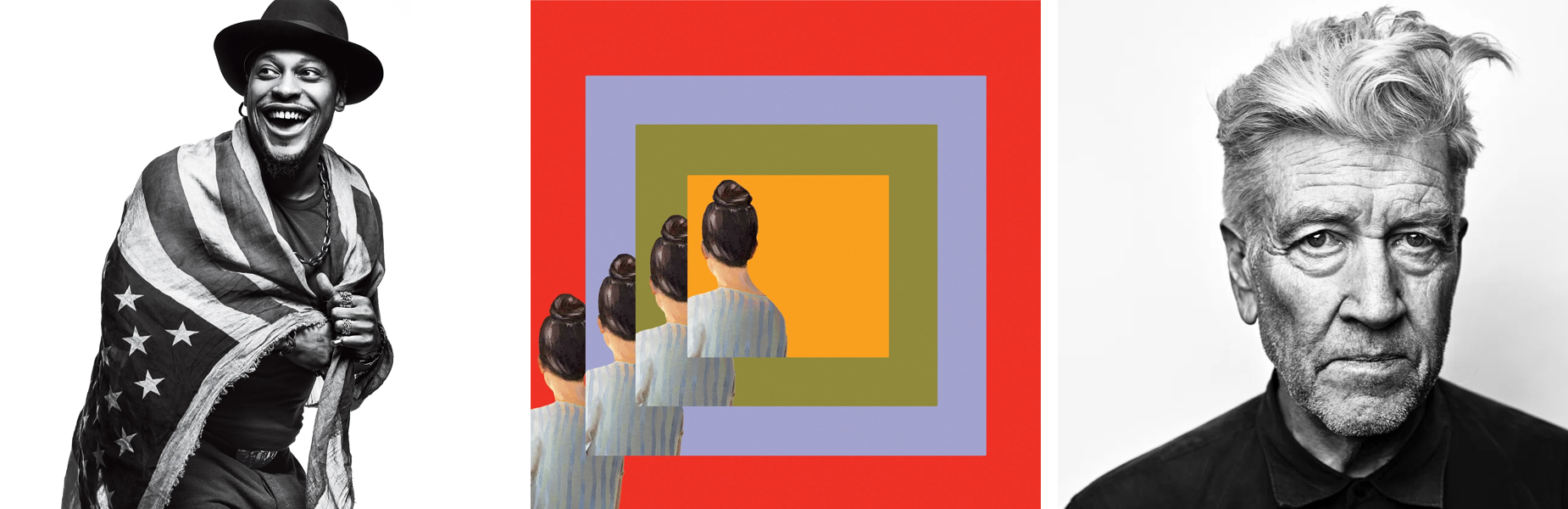
the complete D’Angelo, 1974–2025 (2025)
a soundtrack to Jess Gibson’s The Good Eye (2026)
David Lynch’s world (2026)
Let me acknowledge meteorological and astronomical spring are different. Meteorological spring, which runs March 1–May 31 in the Northern Hemisphere, tracks temperature cycles and weather patterns. Astronomical spring is tied to Earth’s orbital position and ends this year on June 20, at the summer solstice.
The gig at Zankel Hall, Carnegie’s smaller sister venue, saw So Percussion debut a sequel to Brassland’s 2015 release Music for Wood & Strings. — Bandcamp | Streaming Services
In 2021, we released a follow-up of sorts, A Record Of, a collaboration between the quartet and Buke & Gase. Two years later, Tim became So Percussion’s executive director, one of several developments that put us in closer contact again. — Bandcamp | Streaming Services
I encourage you to dig into both of these LPs. Start with this playlist from an early 2022 installment of AHB’s Goodies to hear them in a wider context.

Matthew has announced a memoir coming out next month that expands on his Harrison text, exploring the connections between listening to music and processing grief.

I appreciate the healthier media ecosystems arising in the wake of peak Internet 2.0 speculation. I found this remembrance of Doug in Hellgate to be an appropriately enigmatic account of what it was like to encounter him:
The last time I was at the Paramount, to see Cindy Lee last November, I recognized Shaw in the crowd on the way out. I had seen on social media that he had been working on an album with Animal Collective’s Josh “Deakin” Dibb,* so I walked up and told Shaw, “Can’t wait for the album.” He looked at me, a stranger, startled, and asked, “What album? She has a new album?” (He thought I meant Cindy Lee.) I said, “Nah, man, your album!” He said, “Oh. I don’t think anyone’s ever said that to me before.” I shook his hand and sped out the door.
For a deeper sense of the work Doug left behind, I will recommend this live bootleg recorded at Tubby’s in Kingston in upstate New York.
* The writer likely meant a different Animal Collective member, Brian Ross Weitz aka Geologist. In 2025, he released A Shaw Deal, credited to Geologist & D.S., which draws from short clips Shaw started posting to Instagram during the pandemic. Weitz edited, looped, and reworked some of those clips into the finished record.