
David Lynch's Deathday
revisit the music of this kinky traditionalist, whose timeless Americana hallucinations may outlive us all.
This is a mixtape delivery service. If you find joy or inspiration in it, I’d be delighted by your paid subscription (often discounted to $25 annually). This post is part of my Artist Primers series — human-curated entry points into the discographies of some major artists and cult figures. The section now includes new or newly updated playlists on the Grateful Dead, Geese, D’Angelo, and Willie Nelson.
# of Tracks: about three dozen recordings
Length: 2 hours & change
Themes: a non-musician channeling his vision through quirky icons like Angelo Badalamenti, Roy Orbison, Julee Cruise & Jimmy Scott ~ the mystery of life, the mystery of love ~ an eccentric traditionalist ~ 1950s vibes expressed through a 1990s lens ~ a Midwest sensibility twisted by time spent in Philadelphia, Los Angeles, and the Pacific Northwest
Links: Spotify | Apple Music | YouTube
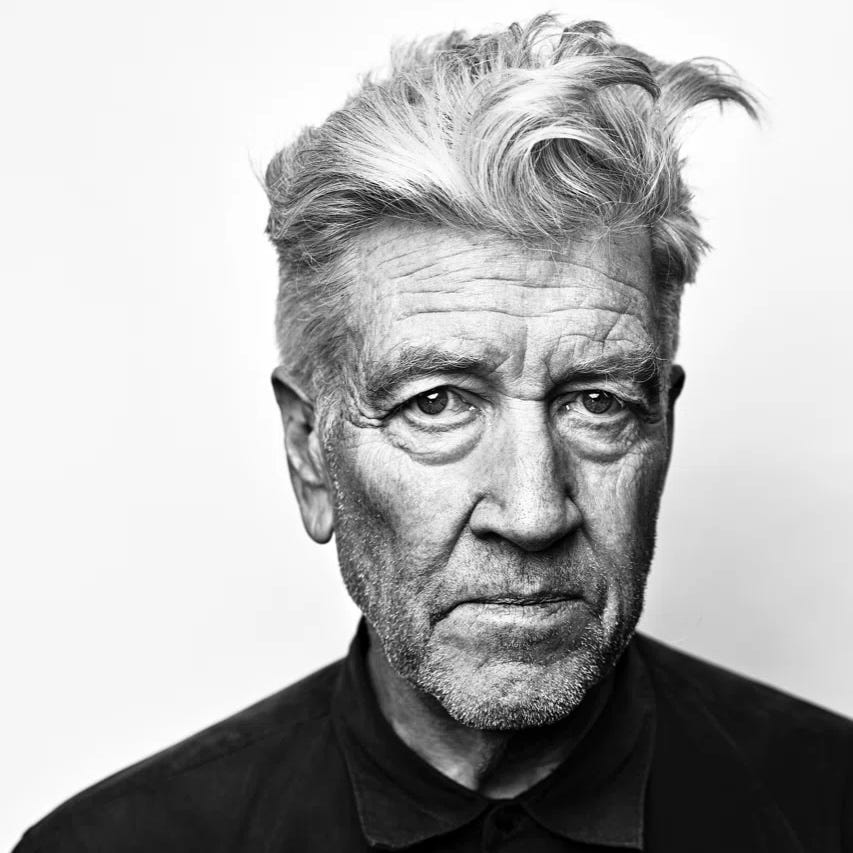
Just as every child has a mother, one of life’s few certainties is how birthdays stick to us—an inescapable badge of identity. Not knowing yours signals childhood deprivation or neglect, perhaps the result of poverty, or being born during plague or war, or in a society less focused on record-keeping than our own.
By contrast, the day we take our last breath remains life’s ultimate enigma, the final mystery of our personal narrative. I think David Lynch would have loved that perplexity, which is why I’m posting this to mark his deathday, a year ago today, on January 16, 2025.
If there are two main types of artists—those you like and those you don’t care for—there is also a third, rarer kind: artists you feel lucky to have lived alongside. These are world-historical figures who, by accident of birth, were your contemporaries—creators whose work leaves you gobsmacked that you could experience it directly, in real time, with only a small modicum of effort or expense. For me, David Lynch was one of those figures.1
I’ll admit there are aspects of Lynch’s work I struggle with. He was often allergic to traditional narrative.2 In many respects, he was an artist who coasted on vibes.
But oh, what a vibe!
He crafted a singular Americana all his own—kinky yet retro-gender-traditionalist, the vision of a man who loved pin-up gals and classic cars and never apologized for it, yet also understood the consequences of our American dreams. He was both apocalyptic and nostalgic about the country he adored, holding at once the destruction wrought by his desires and their strange beauty. Both the unspeakable demons unleashed on Hiroshima and Nagasaki by the atomic bomb, and the eerie beauty of mushroom clouds seen against an unblemished western sky.3 Both the man-machine hybrids of period automobiles and the unsustainable myth of Manifest Destiny that sent them crisscrossing the nation’s highways. Both a perfect cup of coffee with apple pie and the social strictures of 1950s America that produced places like the Double R Diner.
That tension—the collision of Americana and anxiety—is what we feel in a David Lynch film or recording. The visuals portray a dream life. The real tensions ane only grappled with (and to a lesser extent resolved) in the sound of his films.
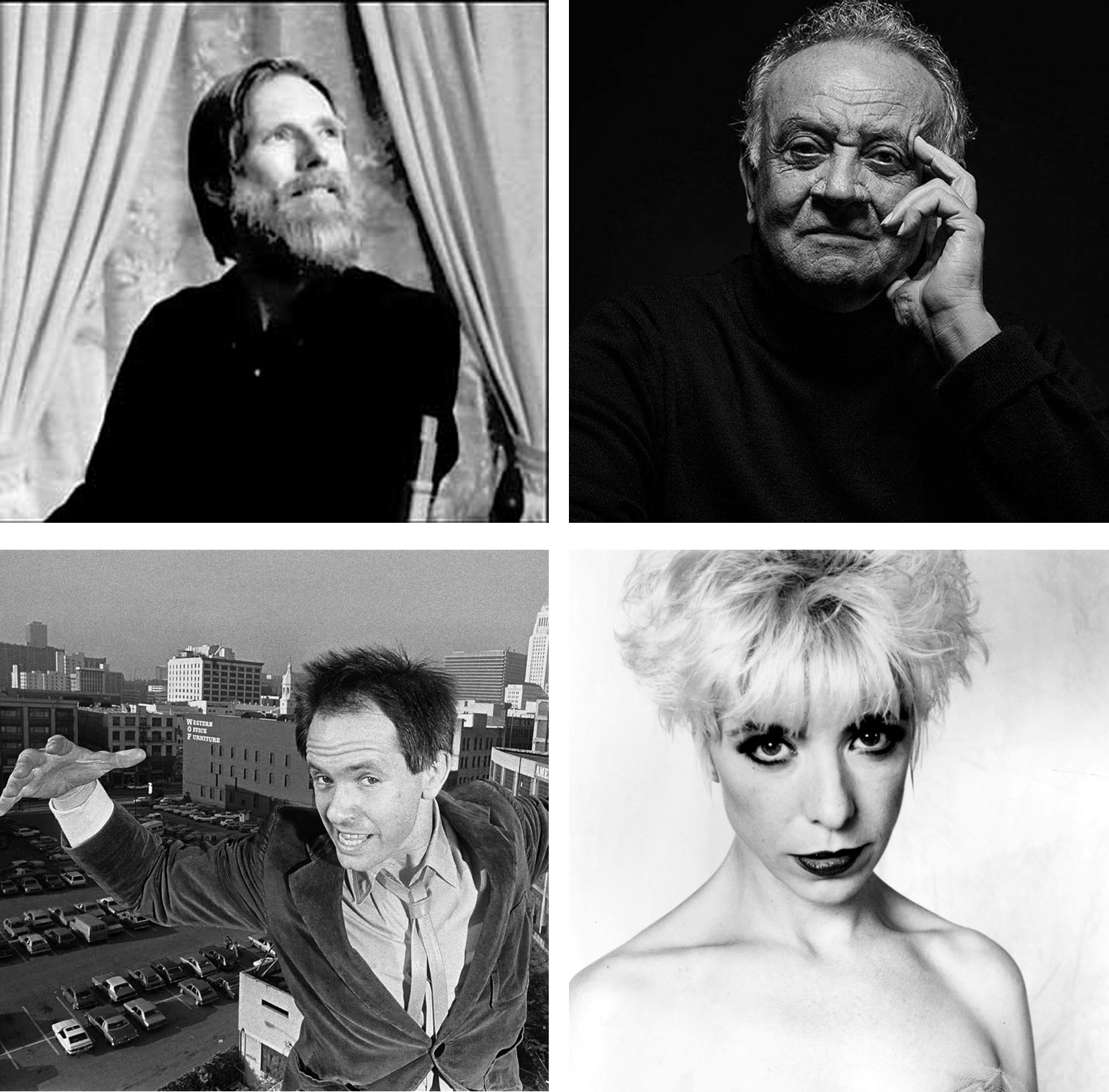
Musicians were his muse and amanuensis, his moral cartographers and emotional cinematographers—shaping the feel of his productions and making his strange visions resonate, simultaneously funny and chilling to the bone. Even his collaborators’ names carry magic: Alan Splet, Angelo Badalamenti, Julee Cruise, Peter Ivers. Has any director/composer pairing ever matched a single one of those team-ups? Lynch repeated that feat at least a half-dozen times. To these musicians, he was a true boss-slash-patron—completing his own vision while giving them free rein to express their own.4
Find the playlist on… Spotify | Apple Music | YouTube
Others single-artist focused posts on AHB’s Goodies


Sinéad O' Conner's last playlist
Mark Lanegan — a heavy dose & more concisely
The David Lynch playlist includes recordings such as…
^ Julee Cruise: “Falling”
^ Warsaw National Philharmonic Orchestra with conductor Witold Rowicki: “Threnody for the Victims of Hiroshima” (excerpt)
^ The Pixies: “In Heaven” (Live) [composer Peter Ivers, lyricist David Lynch]
^ David Lynch: “Wishin’ Well”
^ Isabella Rossellini: “Blue Velvet” [composed by Bernie Wayne and Lee Morris & popularized by Bobby Vinton]
Bonus: more Lynch
• Here’s what David Lynch thought of your iPhone. Any guess what he would have to say about generative AI?
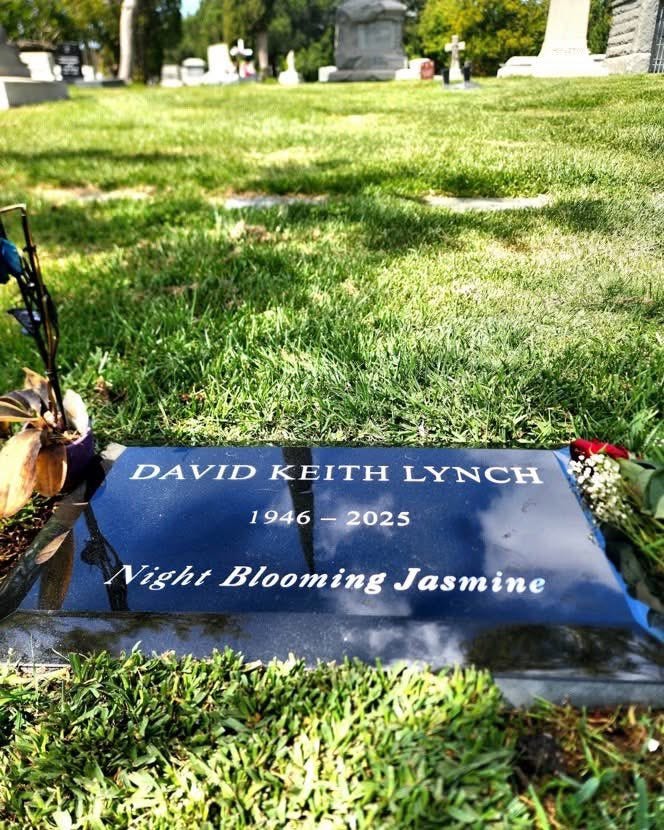
• An Image of his gravesite in Los Angeles: Night blooming jasmine was a through-line in David Lynch’s public pronouncements over the years, such as this from an interview in a 2016 issue of AnOther Magazine:
When you fly into LA at night, it’s all lit up, miles and miles of lights – so beautiful. It’s a very fast image. But within it there are these places that talk about memory. You know, on a summer’s night, maybe more like a spring night, you could drive to certain places and if you smell that night-blooming jasmine, you can almost see Clark Gable or Gloria Swanson. The golden age of Hollywood is still living in some moods here, in the DNA of the city.
• Recommended Reading: Lynch on Lynch (Farrar, Straus & Giroux, 2005 revised edition, originally 1997) interviews with & edited by Chris Rodley: In Rodley’s introduction to the chapter “She Wasn’t Fooling Anyone, She Was Hurt and She Was Hurt Bad: Music and Blue Velvet,” he frames the director’s relationship to music like so:
Lynch might…have proved to be contemporary cinema’s most astute director when it comes to using ‘found’ music. Having renewed the medium with his dense, experimental approach to sound, he also introduced the imaginative and dream-like power of pop and rock to celluloid. Not only are his images transformed by the sounds and sentiments of the music, but these images in turn re-invent the music itself - twisting its meaning or complicating its often simple, emotive intent until the two become inseparable. In Blue Velvet, with scenes such as the one in which Dean Stockwell sings Roy Orbison’s “In Dreams”, Lynch finally unlocked this talent to startling effect.
Later in the same chapter, Lynch discusses his first time collaborating with Angelo Badalamenti with a excitable and believably naive hyperbole that is uniquely Lynchian. The italics and exclamation points!!! below are all from the original text:
…I’m, like, in seventh heaven. I’m in a recording studio, which is the greatest place, and I’m with musicians, who are the greatest people in the world - the greatest people. They sleep late, they’re like children, and they have this unbelievable thing that they don’t talk about. They just do it. It’s a thing that brings all different kinds of people together. And now, without saying anything, they’re really together, making this music. It’s a magical thing! You can do anything. You just have to say what you want. It’s the best! A major event! Angelo brought me into he world of music. I didn’t realize how much I wanted to go there till that happened… Music opens up doors, because even one little sound or a sequence of notes can give you an idea for a story.
If Lynch’s death made you revisit his body of work over the last year, consider buying and reading this book in its entirety, to go deeper in.
• Jherek Bischoff: Chestnuts Roasting on an Open Fire Walk with Me: The mannerisms of an intensely original artist can tip into self-parody. Never have real respect and awareness of that fact coexisted so closely as on this Christmas album by my old pal Jherek Bischoff, who balances the two with grace and affection.
Self-released in December 2017 by Jherek Bischoff (Los Angeles, California, USA)
People Who Died: Ace Frehley • Brigitte Bardot • Cecilia Giménez • Donna Jean Godchaux • Frank Gehry • Hulk Hogan • Jane Goodall • Jimmy Cliff • Joe Ely • Keith McIvor (aka Optimo’s JD Twitch) • Leonard Lopate • Ozzy Osborne • Rob Reiner • Robert Wilson • Tom Lehrer
The passings I’m memorializing in this post beg the question: who is a beast and what is a man?

I’d recommend everyone keep their own list of such figures. Mine includes Bob Dylan, Al Green, Joni Mitchell, Denis Johnson, Nina Simone. My bad—I messed up and missed my chances to see Joni and Nina. (Leonard Cohen, too!) As I age, I am less likely to repeat that kind of mistake.
Lynch’s most family-friendly film, The Straight Story (1999), was perhaps an exception to his usual disinterest in traditional narrative. The entire film is essentially The Odyssey on a riding mower, transposed to the American Midwest.
I watched Twin Peaks: The Return (2017) for the first time last year, shortly after Lynch’s death, and in my estimation, nuclear catastrophe is the story’s central moral and motif.
The 2017 Twin Peaks reboot was odd and miraculous for many reasons, including that most episodes ended with a musical performance at “The Roadhouse,” featuring artists hand-picked by Lynch—among them Nine Inch Nails, Sharon Van Etten, Eddie Vedder, and Chromatics. Perhaps he was trying to make lightning strike a fifth, sixth, or even a twelfth time? I wasn’t as taken with these scenes as with the music woven throughout the show, though Lisse’s “Wild West” was an exception: